You’ve heard it a hundred times: start investing early, let compound interest work its magic, and you’ll thank yourself later. But when you’re staring at a blank brokerage screen with $200 to your name, that advice feels useless. The truth is, learning how to start investing for beginners isn’t about picking the perfect stock or timing the market.
It’s about building a simple system you can stick with for decades.
Here’s what most guides skip: the behavioral side. According to research from DALBAR, the average investor earns roughly 2, 3% less per year than the S&P 500 index itself, not because they picked bad funds, but because they panicked, sold low, and bought high. The math behind this is brutal.
If the market returns 10% annually but you capture only 7%, a $10,000 portfolio grows to roughly $174,000 over 40 years instead of $452,000. That gap isn’t about intelligence. It’s about process.
Let’s build yours.
Why Accuracy Matters Before You Invest a Single Dollar
Investing mistakes hurt twice: first in dollars, then in confidence. A single panic-sale during a downturn can erase years of gains. Worse, one bad experience often convinces beginners that the stock market is a casino, so they retreat to cash and lose purchasing power to inflation forever.
Neither outcome comes from picking wrong stocks. Both come from missing the fundamentals.
The real danger isn’t volatility. It’s acting on emotion without a plan. When the market drops 20% and headlines scream recession, your brain wants to flee.
If you don’t have a written strategy explaining why you own what you own, you’ll make impulsive decisions that lock in losses.
So before we talk about accounts or funds, get this straight: investing is a long-term behavior, not a one-time event. The winning move is boring. You contribute consistently, you stay diversified, and you ignore the noise.
That’s it. The fancy stuff is mostly marketing.
The Hidden Cost of “Safe” Cash
Money sitting in a standard savings account loses value every year. As of 2026, the average savings account yields around 0.5% while inflation typically hovers near 2, 3%. That means your purchasing power shrinks roughly 2% annually.
Over 30 years, $50,000 in cash quietly becomes worth about $27,000 in today’s dollars. That’s not safe. That’s a slow leak.
Investing isn’t about getting rich overnight. It’s about preventing your savings from quietly dying. Stocks historically return 7, 10% annually after inflation over long periods.
No guarantee, but that’s the historical record. The alternative, holding cash forever, guarantees a loss of purchasing power.
How This Guide Is Different
Most beginner articles list account types and throw jargon at you. This one walks you through a decision tree. You’ll learn exactly which accounts to open, which funds to buy, and what to do when the market gets scary.
We’ll cover rules of thumb, real numbers, and specific steps you can complete this week.
What Investing Actually Is (And What It Isn’t)
Investing means buying assets that you expect to grow in value or generate income over time. Stocks, bonds, real estate, and index funds all qualify. The key word is expect.
There’s risk involved. Prices fluctuate. But historically, diversified portfolios trend upward over decade-long horizons.
Saving, by contrast, means parking cash in insured accounts. You earn a small guaranteed return. Your principal never drops.
That’s perfect for emergency funds and short-term goals under five years. It’s terrible for retirement because inflation quietly eats your purchasing power.
Speculating sits at the other end. Day trading, crypto, meme stocks. You’re betting on price movements over days or weeks.
That’s gambling with extra steps. The returns are unpredictable, and most retail traders lose money. If you’re a beginner, skip it entirely.
How Compound Interest Really Works
Here’s the magic formula: you earn returns on your original money, and then you earn returns on those returns. Einstein reportedly called it the eighth wonder of the world. The numbers back that up.
Say you invest $200 monthly starting at age 25. Assuming an 8% average annual return, you’ll have roughly $622,000 by age 65. Start at 35 with the same contribution, and you’ll end up with about $275,000.
The extra decade does more work than doubling your contributions. Time is the lever you can’t buy later.
Compound interest needs time to build momentum. The first decade feels painfully slow. Then growth accelerates like a snowball rolling downhill.
That’s why every expert screams “start early.” Not because they’re boring, but because the math is ruthless.
Core Building Blocks for Beginners
- Stocks (equities): Shares of individual companies. High growth potential, high volatility. You’re betting on one business.
- Bonds: Loans to governments or corporations. Lower returns, lower risk. They provide stability and income.
- Index funds: A basket of stocks that tracks a market index like the S&P 500. Instant diversification in one purchase.
- ETFs (exchange-traded funds): Similar to index funds but traded like stocks throughout the day. Same diversification, slightly different mechanics.
- Target-date funds: A single fund that automatically adjusts its stock/bond mix as you approach retirement. True set-and-forget.
Why Index Funds Are the Default Recommendation
The data is overwhelming. According to the S&P Dow Jones Indices SPIVA report, more than 85% of actively managed U.S. large-cap funds underperform the S&P 500 over a 15-year period. That means professional managers with Wall Street research teams still lose to a passive index fund.
You won’t beat the market consistently. Neither can they.
Index funds also charge tiny fees. The average actively managed mutual fund carries an expense ratio around 0.70%. A solid S&P 500 index fund costs roughly 0.03%.
On a $100,000 portfolio, that’s a $700 annual difference. Over 30 years, the fee gap alone could cost you tens of thousands in lost compounding.
For beginners, a total stock market index fund or an S&P 500 fund is the rational starting point. It’s simple, cheap, and historically reliable. You can always add bonds later as you approach retirement.
The 5-Step Starter Checklist: Before You Open Any Account

Jumping straight into a brokerage account is tempting. Don’t. There’s preparation work that prevents costly mistakes later.
Think of this as laying the foundation before building the house. Each step matters.
Step 1: Build a 3–6 Month Emergency Fund
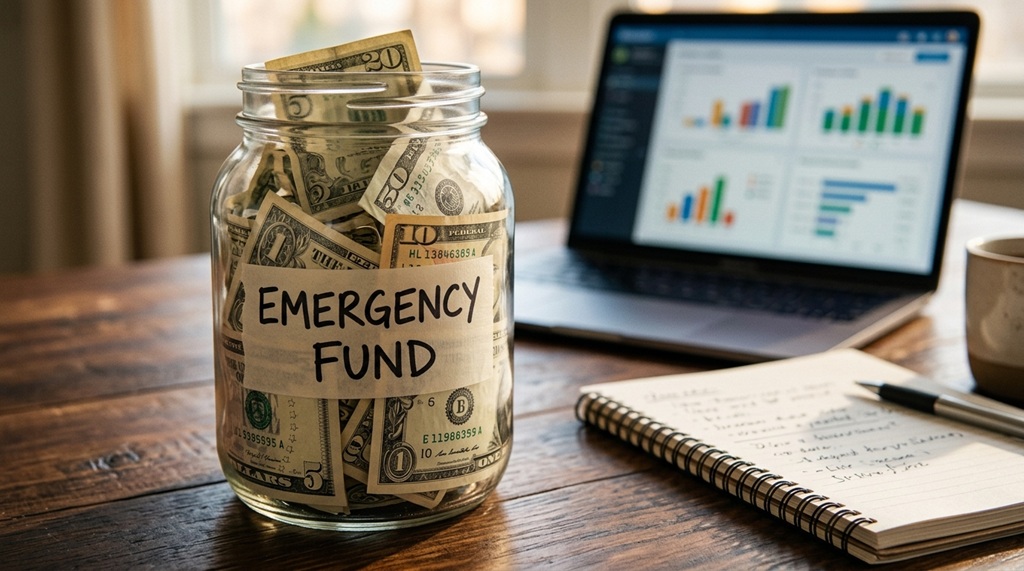
Your investments need protection from your own life. If your car breaks down or you lose your job, you’ll be tempted to sell investments at the worst moment. An emergency fund prevents that.
Keep 3, 6 months of essential expenses in a high-yield savings account (HYSA). As of 2026, you can find rates around 4.00, 4.50% at online banks. That beats the national average of 0.5% by a wide margin.
It’s insured by the FDIC up to $250,000, so your principal is safe.
If you don’t have this yet, make it your first priority. Invest only after your emergency fund is fully funded.
Step 2: Pay Off High-Interest Debt First
Here’s the if/then rule: if your debt interest rate exceeds 7, 8%, pay it off before investing. That’s because the market historically returns about 8, 10% before inflation. Eliminating debt guarantees that return.
Investing in the market only hopes for it.
Credit card debt averaging 20%+ APR makes investing while carrying it financially irrational. The interest compounds against you faster than the market can recover. Student loans at 4, 5% are a gray area. You could justify investing while paying those slowly, especially within a tax-advantaged account.
Step 3: Set a Realistic Monthly Contribution Amount
Start with any number that doesn’t hurt. $50 monthly is fine. The habit matters more than the amount. Once that feels comfortable, increase it by 1% of your salary annually or whenever you get a raise.
Automation is key here.
Set up automatic transfers on payday. You can’t spend what you never see. This is called “paying yourself first,” and it’s the single most effective savings behavior in personal finance literature.
Step 4: Understand Your Time Horizon and Risk Tolerance
Your investment timeline dictates your asset allocation. If you need the money within 5 years, keep it in cash or bonds. If you’re investing for retirement 20+ years away, stocks work in your favor because time smooths out volatility.
Risk tolerance is more emotional. A 60% stock, 40% bond portfolio might look balanced on paper but keep you up at night during a 30% market crash. Be honest with yourself.
If you’ll panic-sell, choose a more conservative mix. It’s better to earn 6% and stick with it than earn 9% and bail after the first downturn.
Step 5: Choose the Right Account Type
This shapes everything downstream. The main options for beginners are:
- Employer 401(k): Contribute at least enough to get the full company match. That’s free money.
- Roth IRA: Post-tax contributions, tax-free growth and withdrawals in retirement. Ideal for young investors in lower tax brackets.
- Traditional IRA: Pre-tax contributions, taxed at withdrawal. Better if you expect to be in a lower tax bracket in retirement.
- Taxable brokerage account: No tax advantages, but no contribution limits either. Flexible access to funds.
Roth IRA wins for most beginners. Your income is likely lower now than in retirement, so paying taxes today locks in a low rate. Contributions can also be withdrawn anytime without penalty, which offers some flexibility.
How to Choose Your First Brokerage (Without Getting Overwhelmed)
You don’t need a financial advisor to start. Modern brokerages have made investing nearly frictionless. The challenge is picking one from dozens of credible options.
Here’s how to narrow it down based on what you actually need.
The core features that matter are: zero commission trades, no account minimums, fractional shares, and automatic investing. Everything else is noise. Research platforms, glossy apps, and analyst ratings are nice-to-haves.
You won’t use them as a beginner.
For a decision-tree approach: if you want full control over fund selection, choose a standard brokerage like Fidelity, Vanguard, Charles Schwab, or similar. If you want automation, choose a robo-advisor that manages your portfolio for you. If you want to start with tiny amounts, a micro-investing app might feel more approachable.
What to Ignore When Comparing Platforms
Ignore marketing claims about “advanced tools” and “premium research.” Beginners don’t need them. They just clutter the interface and encourage overtrading. Ignore sign-up bonuses, too.
A $100 bonus doesn’t matter if the platform encourages bad habits or charges hidden fees.
Focus on the three things that directly impact your returns:
- Trading fees: Should be $0. Double-check for any account maintenance charges.
- Minimums: Look for zero-minimum platforms so you can start with whatever you have.
- Fractional shares: This lets you buy $50 worth of an S&P 500 ETF even if one share costs $500.
Comparison Table: Brokerage Types for Beginners
| Feature | Standard Brokerage | Robo-Advisor | Micro-Investing App |
|---|---|---|---|
| Control | Full control over investments | Minimal control | Minimal control |
| Fees | $0 trades, no account fees | 0.25–0.35% annual management fee | Subscription fee ($1–$5 monthly) |
| Minimums | Often $0 | Varies, often $0–$500 | $0 |
| Best for | Hands-on DIY investors | Set-and-forget investors | Complete beginners starting small |
| Auto-investing | Usually available | Built-in | Built-in |
| Tax optimization | Manual | Automatic (tax-loss harvesting) | Limited |
Which One Is Right for You?
If you’re comfortable selecting one index fund and ignoring your portfolio for years, a standard brokerage works well. You avoid the management fee entirely. If you know you’ll overthink and tinker, a robo-advisor adds a layer of protection against yourself.
The 0.25% fee buys behavioral guardrails.
Micro-investing apps are fine for building the habit, but watch the subscription fee. If you’re only investing $50 monthly, a $3 monthly fee eats 6% of your contribution. That’s worse than any expense ratio in the industry.
You can graduate to a standard brokerage once your account grows.
Your First Investment: A Simple Portfolio for Beginners
Now the real action begins. You’ve funded your account. The market is open.
You’re staring at a search bar with thousands of tickers. Don’t panic. The right first trade is remarkably simple.
For most beginners, a single total stock market index fund or an S&P 500 fund is sufficient. You can add bonds later as your portfolio grows and your timeline shortens. One fund gives you instant diversification across hundreds of companies.
That’s the entire investment strategy, and it’s historically proven.
Two solid options dominate recommendations: Vanguard Total Stock Market Index Fund (VTSAX or VTI ETF) and Fidelity Zero Total Market Index Fund (FZROX). Both offer tiny or zero expense ratios. Both track the entire U.S. stock market.
Both are appropriate for beginners.
How to Set Up Automated Contributions
Automation turns investing from a discipline into a default behavior. Log into your brokerage, find the recurring investment settings, and schedule a weekly or monthly purchase. Choose whatever day aligns with your payday.
Consistency beats timing.
A $200 monthly contribution works beautifully. Some platforms let you set up automatic ETF purchases. Others require you to buy manually each month.
Either way, schedule a calendar reminder. The goal is to make missing a contribution more inconvenient than making one.
When to Rebalance (And When Not to Bother)
If you’re using a single index fund, rebalancing doesn’t apply yet. You own one asset class. As your portfolio grows, you might add bonds and need to maintain a target percentage.
A simple rule: rebalance once per year, not when markets swing wildly.
Avoid the urge to tweak monthly. Each change triggers taxes in a taxable account and invites behavioral mistakes. A target-date fund eliminates this by rebalancing automatically as your retirement date approaches.
That convenience justifies its slightly higher expense ratio for many investors.