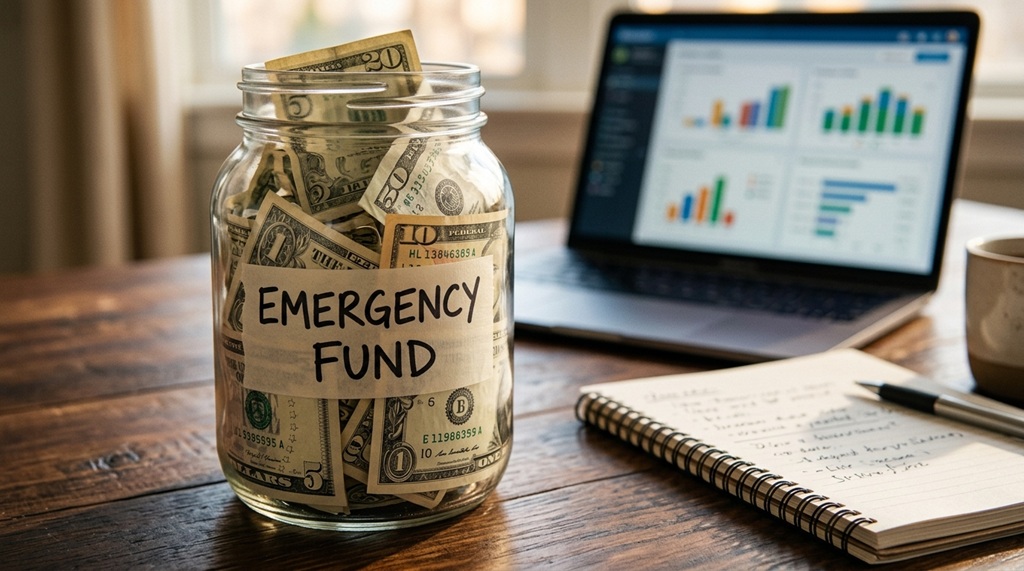
Let’s talk about something that sounds boring but actually buys you freedom: an emergency fund. If you’re wondering how to build an emergency fund without feeling like you’re sacrificing your entire social life, you’re in the right place. The truth is, it’s less about how much you earn and more about having a simple system that runs on autopilot.
Here’s the reality check that motivates most people: the Federal Reserve reports that nearly 40% of U.S. adults would struggle to cover a $400 unexpected expense without borrowing or selling something. That’s not a judgment, it’s a wake-up call. But here’s the good news.
You don’t need to be rich to change that statistic for yourself, and you don’t need a complicated spreadsheet to get there.
Quick Answer
To build an emergency fund, open a separate high-yield savings account. Set up an automatic transfer of a fixed amount each payday, starting with just $20 to $50 per week. Begin with a $500 to $1,000 starter goal, then build toward 3 to 6 months of essential expenses.
Use windfalls like tax refunds to accelerate progress.
Key Takeaways
- A starter fund of $500 to $1,000 handles most common emergencies like car repairs or minor medical bills.
- Automate your savings so you never have to rely on willpower to transfer money.
- Keep your emergency fund in a high-yield savings account, completely separate from your daily spending account.
- Irregular income? Save a percentage of every paycheck instead of a fixed dollar amount.
- Once you hit your target, shift focus to debt payoff and investing, but keep contributing small amounts to account for inflation.
What Is an Emergency Fund (and Why It’s Non-Negotiable)
An emergency fund is a dedicated stash of cash set aside specifically for unexpected, necessary expenses. It’s not a vacation fund, a shopping fund, or a down payment fund. It exists for one purpose: to catch you when life throws a curveball.
Think of it as a financial shock absorber. When your car’s transmission dies, when you get a surprise medical bill, or when your hours get cut at work, the fund steps in so you don’t have to reach for a credit card or a payday loan. That distinction matters because credit card debt at 20%+ APR turns a $1,000 problem into a $1,300 problem within a year.
Why 3–6 Months of Expenses Is the Gold Standard
Financial planners typically recommend stashing away enough to cover three to six months of essential living expenses. That includes rent or mortgage, utilities, groceries, transportation, insurance, and minimum debt payments. The logic is simple: it gives you enough runway to find a new job, recover from an illness, or handle a major repair without panic.
But here’s what most guides don’t tell you. The right number depends on your situation.
| Situation | Recommended Fund Size |
|---|---|
| Stable job, dual income, no dependents | 3 months of expenses |
| Single income, homeowner, or freelancer | 6 months of expenses |
| Seasonal worker or commission-based income | 6–9 months of expenses |
Per the Consumer Financial Protection Bureau, households with liquid savings are significantly less likely to fall behind on bills or rely on high-cost borrowing after a financial shock. That’s why this isn’t optional. It’s foundational.
What Counts as a Legitimate Emergency
Not every surprise expense qualifies as an emergency. A legitimate one is urgent, necessary, and unavoidable. Here’s the practical breakdown:
- Urgent: your water heater leaks and floods the basement
- Necessary: you need your car to get to work and the alternator just died
- Unavoidable: you’re hit with a medical deductible after an ER visit
A legitimate emergency is not:
- A flash sale on electronics
- Concert tickets, even if “they’ll never be this cheap again”
- A vacation, even if you ‘really need one’
- Holiday gifts or birthday dinners
The difference comes down to this: can you delay it, avoid it, or live without it? If yes, it’s not an emergency. Reserve the fund for the stuff that genuinely threatens your stability or safety.
How Much Should You Actually Save? (Start Here)
The biggest mistake people make is staring at a $15,000 goal and feeling paralyzed. You don’t eat an elephant in one bite, and you don’t save three months of expenses in a week. Start smaller.
Much smaller.
The $500–$1,000 Starter Fund: Your First Milestone
Your first goal is a mini fund of $500 to $1,000. This covers the most common financial emergencies that derail budgets. Think car repairs, minor medical bills, or a replacement appliance.
A 2024 survey by the Federal Reserve found that the typical unexpected expense for U.S. households is around $1,000. Knock that out first and you’ve already built a serious safety net.
To hit this milestone, figure out how much you can realistically set aside per month. If that’s $50, fine. If it’s $500, even better.
Every dollar moves you closer.
Calculating Your True Monthly Essentials
Once the starter fund is in place, it’s time to calculate your monthly essentials. This isn’t your total income or your full spending. It’s just the bare minimum needed to keep your life running.
Sit down and list the following:
- Rent or mortgage payment
- Utilities (electricity, water, gas, internet)
- Groceries and household essentials
- Transportation (gas, insurance, public transit)
- Minimum debt payments on all loans and credit cards
- Health insurance premiums and copays
- Childcare, if required for work
Total that up and multiply by 3 for the low end or 6 for the high end. That’s your target. Write it down.
Keep it somewhere visible. That number is your ultimate finish line.
Adjusting the Target Based on Your Situation
Your income stability should drive your savings target. If your paycheck is predictable and you’ve been at your job for years, three months might feel fine. But if you’re freelancing, working on commission, or in a seasonal industry, you need more cushion because your income has natural gaps.
Homeowners should also lean toward the higher end. Repairs like a new roof or a broken HVAC system can easily run into the thousands. Renters have fewer catastrophic expenses, so they can usually stick with the standard 3 to 6 months.
Step-by-Step: How to Build Your Emergency Fund (Without Feeling the Pinch)
Now for the part you actually came here for. Building the fund without making yourself miserable. The secret isn’t discipline.
It’s automation and a little bit of strategy.
Step 1: Track Your Spending for One Month
You can’t know what you’re working with until you see where your money actually goes. Use a budgeting app, a spreadsheet, or just a notebook. Track every coffee, every streaming subscription, every grocery trip.
One month is enough to spot patterns and find savings opportunities.
Step 2: Set a Realistic Monthly Savings Target
Look at your tracked spending and figure out what you can genuinely cut. Maybe it’s the $40 cable package you barely use or the $60 a month in takeout lunches. Even $25 a week adds up to $100 a month, which is $1,200 a year.
A good starting goal: aim to save 10% of your take-home pay. If that’s too aggressive, start with 5% and increase it later. The point is to start.
Step 3: Open a Separate High-Yield Savings Account
This step matters more than you think. Open a high-yield savings account (HYSA) at a different bank than your checking account. As of 2026, these accounts are still offering APYs around 4% to 5%, compared to the 0.01% most standard checking accounts pay.
That’s the difference between your money sitting still and actually growing.
FDIC insurance covers up to $250,000 per depositor, per bank, so your money is protected. And because it’s at a separate bank, you’ll have to think twice before transferring money out on impulse.
Step 4: Automate Your Transfers (Pay Yourself First)
Set up a recurring transfer that moves money into your emergency fund the same day you get paid. Treat it like any other bill. Automate it and you’ll never see the money in your checking account, which means you won’t miss it.
Here’s the if/then logic that makes this work:
- If you get paid biweekly, set the transfer for payday.
- If your income varies, transfer a fixed percentage (like 10%) of each paycheck.
- If you’re self-employed, transfer a percentage of every client payment you receive.
Step 5: Use Windfalls to Accelerate the Process
Tax refunds, work bonuses, cash gifts, side hustle income. Any windfall should go straight into your emergency fund until you hit your target. It’s not money you’d normally budget for, so you won’t feel the pinch.
One decent tax refund alone could knock out your entire starter fund.
Step 6: Reassess and Replenish as Life Changes
Your target isn’t static. If you get a raise, increase your contribution. If you move to a more expensive city, recalculate your monthly essentials.
And if you ever need to dip into the fund for a real emergency, make replenishing it your top financial priority afterward.
Where to Keep Your Emergency Fund (and What to Avoid)
Where you park your money is almost as important as how much you save. The goal is a balance of three things: safety, liquidity, and a reasonable return.
High-Yield Savings Accounts vs. Regular Checking
A high-yield savings account is your best bet for the bulk of your emergency fund. Your money is safe, insured, and earns a competitive interest rate. Withdrawal times are usually one to two business days, which is plenty fast for any real emergency.
Your regular checking account, on the other hand, keeps your money too accessible. Easy access means easy spending. And with near-zero interest, it’s not working for you at all.
Money Market Accounts and CDs: Are They Worth It?
Money market accounts can work well if you want check-writing privileges. They often offer rates comparable to HYSAs, but they may require higher minimum balances. Certificates of deposit (CDs) lock your money up for a set term, which makes them a poor fit for an emergency fund unless you’re using a CD ladder with staggered maturities.
What NOT to Do: Stocks, Crypto, and Retirement Accounts
Never, under any circumstances, put your emergency fund in stocks, crypto, or any investment that can lose value. The stock market can drop 20% overnight. Your emergency fund needs to be there at full value, not down 20% when you need it most.
The same goes for retirement accounts. Withdrawing from a 401(k) before age 59½ triggers a 10% penalty plus income tax. That turns a $5,000 emergency into a $6,000+ hit.
Not worth it.
Quick Comparison Table: Account Options at a Glance
| Account Type | Safety | Liquidity | Typical APY (2026) | Best For |
|---|---|---|---|---|
| Checking account | FDIC insured | Immediate | 0.01%–0.10% | Daily spending |
| High-yield savings | FDIC insured | 1–2 business days | 4%–5% | Emergency fund |
| Money market account | FDIC insured | Immediate to 1 day | 3.5%–4.5% | Larger balances |
| CD (single term) | FDIC insured | Penalty for early withdrawal | 4%–5% | Not ideal for emergencies |
Common Mistakes That Sabotage Emergency Funds

Building the fund is hard. Keeping it intact is harder. Here are the most common ways people derail their own progress, and how to avoid each one.
Using the Fund for “Pretend Emergencies”
A spontaneous dinner out isn’t an emergency. Neither is a new phone because you’re bored with your current one. Before you touch the fund, ask yourself one question: will I face serious, unavoidable harm if I don’t spend this money?
If the answer is no, don’t touch it.
Stopping After Hitting the Target
Many people reach their savings goal and then stop contributing entirely. That’s a mistake. Inflation slowly erodes the buying power of your cash.
Prices go up, and your fixed dollar amount buys less over time. Keep making small, regular contributions to keep pace.
Ignoring Inflation and Interest Rates
If your emergency fund sits in a standard brick-and-mortar savings account earning 0.01%, it’s losing value every single year. As of 2026, the average inflation rate hovers around 3%. Switch to a high-yield account and your money keeps up much better.
Paying Off Debt Before Building Any Savings
The conventional wisdom was to throw every extra dollar at debt before saving anything. But that approach leaves you vulnerable. If an emergency hits mid-payoff, you’ll have to use a credit card anyway, undoing your progress.
A smarter move is building a $1,000 starter fund first, then aggressively tackling debt.
Keeping the Fund in the Same Account as Daily Spending
If your emergency fund sits in your checking account, you will spend it. It’s not a character flaw. It’s human nature.
Make the transfer friction harder by keeping it at a separate bank or credit union. Out of sight, out of mind, and out of your spending impulse path.
Common Mistakes That Sabotage Emergency Funds
Building the fund is hard. Keeping it intact is harder. Here are the most common ways people derail their own progress, and how to avoid each one.
Using the Fund for “Pretend Emergencies”
A spontaneous dinner out isn’t an emergency. Neither is a new phone because you’re bored with your current one. Before you touch the fund, ask yourself one question: will I face serious, unavoidable harm if I don’t spend this money?
If the answer is no, don’t touch it.
Stopping After Hitting the Target
Many people reach their savings goal and then stop contributing entirely. That’s a mistake. Inflation slowly erodes the buying power of your cash.
Prices go up, and your fixed dollar amount buys less over time. Keep making small, regular contributions to keep pace.
Ignoring Inflation and Interest Rates
If your emergency fund sits in a standard brick-and-mortar savings account earning 0.01%, it’s losing value every single year. As of 2026, the average inflation rate hovers around 3%. Switch to a high-yield account and your money keeps up much better.
Paying Off Debt Before Building Any Savings
The conventional wisdom was to throw every extra dollar at debt before saving anything. But that approach leaves you vulnerable. If an emergency hits mid-payoff, you’ll have to use a credit card anyway, undoing your progress.
A smarter move is building a $1,000 starter fund first, then aggressively tackling debt.
Keeping the Fund in the Same Account as Daily Spending
If your emergency fund sits in your checking account, you will spend it. It’s not a character flaw. It’s human nature.
Make the transfer friction harder by keeping it at a separate bank or credit union. Out of sight, out of mind, and out of your spending impulse path.
Expert Tips for Staying on Track
Automation wins every time. Our research shows that people who automate their savings are far more likely to hit their goals than those who rely on willpower alone. Set it once, and let the system do the heavy lifting.
Use Sub-Accounts or Savings Buckets
Many high-yield savings accounts let you create separate buckets within one account. Label one “Emergency Fund,” another “Car Repairs,” and another “Medical.” This mental separation helps you avoid raiding your emergency fund for a predictable expense like new tires.
Reassess Your Target Annually
Life changes fast. A raise, a new baby, a move, or a job loss all shift your monthly essentials. Set a calendar reminder to recalculate your target every January.
It takes ten minutes and keeps your safety net sized correctly.
Celebrate Small Milestones
Hitting $500 is worth acknowledging. So is $1,000, and so is your first full month of expenses. Reward yourself in a small way that doesn’t drain the fund.
A coffee, a movie, a nice dinner. These micro-celebrations keep you motivated.
Real Scenarios: What the Fund Actually Does for You
Let’s look at three real-world situations and how the fund changes the outcome.
Scenario 1: The Car Repair
Your transmission fails on the highway. The repair estimate is $1,800. Without an emergency fund, you put it on a credit card at 22% APR.
Paying $100 a month, it takes 22 months to clear and costs over $2,100 total. With a fully funded emergency fund, you pay $1,800 cash and move on. No interest, no monthly drain.
Scenario 2: The Job Loss
You’re laid off with no warning. Your monthly essentials total $2,800. With six months of expenses saved, that’s $16,800 in the bank.
You have time to search for the right role instead of panic-taking the first offer. You avoid dipping into retirement savings and paying early withdrawal penalties.
Scenario 3: The Medical Bill
An unexpected ER visit leaves you with a $1,200 bill after insurance. With a starter fund of $1,000, you cover most of it and use a payment plan for the rest. Without it, you’re choosing between groceries and the bill.
The fund doesn’t make the bill fun. It makes it survivable.
When to Shift Focus: Debt Payoff vs. Emergency Savings
The order of operations here matters more than most people realize. It’s not an either-or decision, and the right answer depends on your debt situation.
If You Have High-Interest Debt (Above 10% APR)
Build a $1,000 starter emergency fund first. Then shift your extra cash to debt payoff. The math works in your favor because credit card interest compounds faster than your savings could grow.
Once your high-interest debt is gone, build your full 3 to 6 month fund.
If You Have Low-Interest Debt (Under 5% APR)
Build your full emergency fund before accelerating debt payments. Low-interest loans like federal student loans or a mortgage don’t create the same urgency. Your cash is better used as a safety net than as an early payoff tool.
If You Have Irregular Income
Save a percentage of every single paycheck, no matter how small. If 10% feels too tight, start at 5%. During good months, put in more.
During lean months, put in less. The system keeps working even when your income fluctuates.
Frequently Asked Questions
Can I build an emergency fund while paying off debt?
Yes, you can and you should. Start with a $500 to $1,000 starter fund first. Then split your extra cash between debt payoff and savings.
Even $25 a month toward savings keeps the momentum going while you tackle high-interest balances.
How fast should I save my emergency fund?
There’s no one-size-fits-all timeline. A realistic pace is 6 to 12 months to reach your full target. If you can save faster with windfalls or aggressive budgeting, great.
If not, consistency beats speed every time.
Is $1,000 enough for an emergency fund?
It’s a solid start, but not enough long-term. A $1,000 starter fund handles minor emergencies like car repairs or small medical bills. It won’t cover major expenses like a roof replacement or three months of unemployment.
Keep building toward 3 to 6 months of essentials.
Should I include my emergency fund in my budget as an expense?
Yes. Treat it like any other bill. Give it a fixed line item in your budget, just like rent, groceries, or your phone plan.
When it’s a line item, you’re less likely to skip it in favor of variable spending.
What if I have irregular income and can’t save a fixed amount?
Save a percentage instead of a dollar amount. If you’re a freelancer, transfer 10% of every client payment you receive. During high-earning months, you’ll save more.
During slow months, you’ll save less, but you’ll still be saving.
Where does an emergency fund sit vs. a retirement account?
They serve completely different purposes. An emergency fund is liquid cash, accessible within days, earmarked for unexpected needs. A retirement account is for long-term growth, with penalties for early withdrawal.
Keep them separate. Never treat your 401(k) as your emergency fund.
Final Word: Start Small, Stay Consistent
The hardest part of building an emergency fund is taking the first step. Not the first thousand dollars, just the first transfer. Open a high-yield savings account today, and automate $25 next payday.
That’s it. That’s the whole secret.
Once you taste the relief of paying a surprise bill without breaking a sweat, you’ll be hooked. The fund grows. The stress shrinks.
And you gain something money can’t buy: the confidence that you can handle whatever comes next.
Start today. Your future self will thank you.
Final Word: Start Small, Stay Consistent
The hardest part of building an emergency fund is taking the first step. Not the first thousand dollars, just the first transfer. Open a high-yield savings account today, and automate $25 next payday.
That’s it. That’s the whole secret.
Once you taste the relief of paying a surprise bill without breaking a sweat, you’ll be hooked. The fund grows. The stress shrinks.
And you gain something money can’t buy: the confidence that you can handle whatever comes next.
Start today. Your future self will thank you.